

It was not a dark and stormy night. In fact it was a bright, sunny day that led to an odd and unexpectedly mysterious adventure hinting at certainty yet filling me with confusion. My husband Stephen and I were in Australia on our way in a private catamaran ferry to Berriedale, a suburb of Hobart, Tasmania and bound for MONA, the Museum of Old and New Art. As we entered the boat’s VIP section lounge, happy fellow passengers were gobbling appetizer cakes and tossing back mimosas or something harder. Our Australian guide, Nate hurried to snag us a table. “Ovah he-ah,” he called, pointing to two bar stools. Adjusting well to Downunder English after 15 days in Australia, Stephen and I sat with him “over” there. As we drank and nibbled, we talked about our favorite genres of art, and I mentioned examples dating from the mid-twentieth century or much earlier. Nate nodded his enthusiasm for including Richard Diebenkorn’s southern California paintings, but with a knowing look he said the museum visit we were about to have would be like no other we ever had experienced, he’d wager.
The boat docked at the base of an imposing cliff. After climbing a long flight of stairs, we reached a terrace and the site of the museum. We saw no grand Beaux Arts museum building. Instead, a broad glass door built into the cliff side slid open to reveal a lobby and an elevator. From there we descended through three levels of Triassic sandstone comprising the headland where we docked. The museum was carved into the stone and also extended underground, running below vineyards owned by David Walsh, the museum’s founder, current owner, and decider. An Australian businessman, Walsh worked with architects and other arts professionals to build a site displaying his unusual and vast collection of art works and artifacts, representing more than three millennia of world cultures. At first viewing, the collection seemed eclectic and installed without a curatorial plan. It would take me a while to understand why Walsh called this self-contained realm of mysteries the Museum of Old and New Art because throughout the museum, antiquities were installed right next to contemporary works. I did not see the curatorial point. Later, however, I sensed a meta message: a philosophical connection might exist between the collected objects. Perhaps the intentional artworks, ritual artifacts, and ancient tablets were inviting me to think about them differently, not in terms of their origins, literal meaning, or aesthetic attributes, but about their relationship and their effect on myself and on the spaces in which we were viewing them.
As I had said to Nate during our ferry conversation, I liked Diebenkorn’s paintings for their color, their light, and the way he massed broad paint strokes. I was used to thinking about art works as objects and in their historical context. While I chatted about Diebenkorn’s art with Nate, I never mentioned if his work had affected me personally. In contrast, as we explored the museum’s galleries of contemporary works sharing space with antiquities, I began to see that the installations were prodding us to react personally to them, to engage with the dynamic between those objects.
Long after our visit, I learned that David Walsh built his collection on what he considered life’s basic duality—sex (or perhaps creation) and death, and his premise suggests more dualities in our lives. Dual systems express themselves in two ways, and in our modern culture we have examples like Morse Code with its long and short signals, Braille with its raised and unraised bumps, and the binary number system, expressed in binary code. Now, I do not know Morse Code, the Braille reading system, nor binary coding. They are totally enigmatic.
I assume MONA’s winding, unpredictable galleries and their installations are equally and purposely enigmatic, that Walsh wants above all to puzzle his museum visitors, to engage them in decoding not only the enigma of the exhibitions but also dare to decode the mysteries of their own lives. He suggests the museum’s premise mirrors the defining boundaries of life— beginning and end, birth and death, alpha and omega and, furthermore, contemplation of the mystery that lies between them.
Walsh and his team wanted the energy created by these contrasting elements to inspire or irritate the visitor, but never to leave that person indifferent. The displays embody Walsh’s provocation, as if to say, “Here is an enigma. Are you going to wrestle with it or flee? I challenge you to learn its secret.”
Buried below ground, MONA entices the visitor to seek its secrets, just as a cave might seduce a spelunker or caver. To quote John Chadwick, the co-decoder of ancient Cretan Linear B writing, “The urge to discover secrets is deeply ingrained in human nature; even the least curious mind is roused by the promise of sharing knowledge withheld from others.” He was talking about language and mysterious scripts. His breakthrough work in a sense revealed secrets of an ancient world that changed common assumptions about its cultures. When I learned to read and speak French and Italian, I had the opportunity to learn more about the cultures that produced those languages. When I learned another language written in a completely different script, a formerly enigmatic code, I felt as though I had decoded secrets. A new world opened wide.
That decoding adventure continued in our last hour before the museum closed. We were ambling down a tight corridor and stumbled upon another installation built into the museum. Kryptos, a site-specific artwork filled and defined a room dark except for faintly glowing underfloor lighting. Like a beckoning cave, it was irresistible. We entered and within two steps, a high, black wall stopped us. It forced us to choose a right or left turn. I chose right and plunged into three chambers and a mystery.
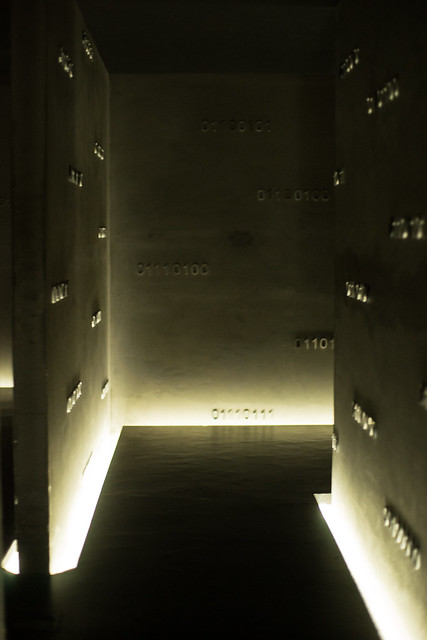
Along the walls, illuminated small cuneiform-inscribed tablets in recessed cases interrupted a series of number ones and zeroes accompanying scattered English words. What did this work mean and who had created it? None of the museum collection had attribution labels. I did not scan a nearby QR code at the time to read text about any of the works, but through email correspondence with the artist who created Kryptos I learned its story and its deeper meaning.
Brigita Ozolins, an artist and Adjunct Senior Lecturer in Fine Arts at the University of Tasmania, Hobart, received David Walsh’s commission to create this work in 2005. As Adam Meredith said in a statement introducing his documentary video, Kryptos responds to specific objects in Walsh’s collection that depict cuneiform, one of the earliest known forms of writing and expands on them with binary code and letters that line the walls. The tablets are part of Walsh’s original collection. The 3,000 laser-cut binary code numbers and the letters running along Kryptos’ walls translate the tablets.
Cuneiform is a writing system consisting of wedge-shaped characters pressed into clay or engraved in stone. The writings are from sections of the Babylonian Epic of Gilgamesh, written around 2700 BCE. In an email, Ozolins kindly translated them for me and also sent the complete lines of alphabetic script that accompanied them. Ozolins says she [quote] “chose to encode the Epic in binary to juxtapose a contemporary code with an ancient one, and because it is as minimal and elegant as cuneiform, just zeros and ones in endless combination.” [end quote]
The tablet in the first case presents text from the epic’s opening: It reads, “He who saw the deep, the foundation of the country. He saw the secret and uncovered the hidden. He brought back a message.” The Roman characters spell “DEEP FOUNDATION SECRET HIDDEN.”
Was this part of the work an overall statement about the concept underlying Walsh’s collection and its installation underground in both gloomy and artificially-lit passageways that simultaneously inspire unease and exaltation?
I walked into the next “chamber” sitting within the walls I had left. Its tablet contained an inscription from about two-thirds into the epic. It read, “Let my eyes see the sun and be sated with light! The darkness is hidden, how much light is there left? When may the dead see the rays of the sun?” On a lighter note, I could imagine that this section reflected the visitor’s anxiety about returning to the museum terrace, sunlight, and fresh air.
I reached the innermost chamber of this labyrinthine space. Its engraved passage came from near the epic’s end, immersed in language about death. The Roman letters nearby spelled SEES FACE DEATH HEARS VOICE.
This last artistic choice confused me until thinking about it later, I remembered the theme of dualities. Birth and death, light and darkness, and new and ancient technologies. All of these pairs contribute to Ozolins’ creation of a work I think is emblematic of the entire Museum of Old and New Art. She perfectly captures what David Walsh wanted his museum to signify. Kryptos also surpasses Walsh’s concept. Although Kryptos’ message was obscure and literally dark when I viewed the work, I nevertheless felt embraced and reassured within its deep shadows and uncertain light. Kryptos defined a sort of sacred space about communication. The juxtaposition of an ancient arcane script with binary code suggested that as a species we humans are determined to record our thoughts, dreams, fears and our data. Posterity may have difficulty in understanding our message, but when the text reveals its meaning it leads from darkness to light.
We left the museum shortly after experiencing Kryptos. A back exit stairway led to light and the pier, and to our ferry returning us to Hobart. Nate was so right. I had never experienced a museum quite like MONA nor a work like Kryptos.

 Susan Bass Marcus Writes
<
div dir=”ltr”>
<
blockquote type=”cite”>
LikeLike
I shared this amazing visit with you in Hobart, Tasmania and was delighted to witness your brilliant explanation of this most interesting piece of art. I was even more impressed with the enthusiasm and agreement of the artist herself when she read this piece. So well done! A mysteriously wonderful museum, MONA deserves this well thought out exegesis of the art work’s message which in a larger sense decoded the purpose underlying this wonderful and amazing institution.
LikeLiked by 1 person